
Türkiye’deki öğrencilerimiz Türkçe versiyona buradan ulaşabilir.
Jeet Kune Do (Chinese: 截拳道; “way of the intercepting fist“; abbreviated JKD) is a martial art conceived and practiced by martial artist Bruce Lee. It was formed from Lee’s experiences in unarmed fighting and self-defense as a new school of martial arts thought.

The core of Jeet Kune Do is the interception of the opponent, making corresponding responses or counterattacks that strike at incoming attacks. JKD incorporates a set of principles to help practitioners make instant decisions and improve their physical and mental self, intended to have practical applications in life without the traditional routines and metaphysics of conventional martial arts. As an eclectic martial art, it relies on a fighting style heavily influenced by Wing Chun, taekwondo, boxing, fencing, and jujutsu.
Bruce Lee himself never formalized Jeet Kune Do before he died. This necessitated later JKD practitioners to rely upon their own interpretation of the philosophy created by Bruce Lee.
Overview and Philosophy
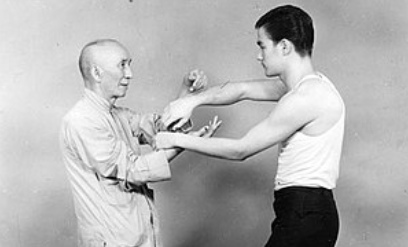
In his youth, Lee began studying Wing Chun under the martial artist Ip Man. He researched other fighting styles and formed his own martial art in 1962, called Jun Fan Gung Fu. However, around 1964, following his encounter with Wong Jack-man, Lee disavowed the rigidity of systematized martial arts. He began a journey of research to refine his way of practicing martial arts. In 1965, he outlined the basic concepts of Jeet Kune Do in a press interview, but it wasn’t until 1967 that he named it Jeet Kune Do. Initially, Lee struggled to name his art as he aimed to avoid crystallization of its essence; however, the need for a reference led him to conclude on a name.
“I have not invented a ‘new style,’ composite, modified or otherwise that is set within distinct form as apart from ‘this’ method or ‘that’ method. On the contrary, I hope to free my followers from clinging to styles, patterns, or molds. Remember that Jeet Kune Do is merely a name used, a mirror in which to see ourselves. . . Jeet Kune Do is not an organized institution that one can be a member of. Either you understand or you don’t, and that is that. There is no mystery about my style. My movements are simple, direct, and non-classical. The extraordinary part of it lies in its simplicity. Every movement in Jeet Kune Do is being so of itself. There is nothing artificial about it. I always believe that the easy way is the right way. Jeet Kune Do is simply the direct expression of one’s feelings with the minimum of movements and energy. The closer to the true way of Kung Fu, the less wastage of expression there is. Finally, a Jeet Kune Do man who says Jeet Kune Do is exclusively Jeet Kune Do is simply not with it.” — Bruce Lee
The metaphor Lee borrowed from Chan Buddhism was of constantly filling a cup with water and then emptying it, used for describing his philosophy of “casting off what is useless.” Lee considered traditional form-based martial arts, which practiced pre-arranged patterns, forms, and techniques, to be restrictive and ineffective in chaotic self-defense situations. He believed that real combat is alive and dynamic and conceived Jeet Kune Do to enable practitioners to adapt to changing live combat. According to Lee, real martial artists judge a technique worthy of adoption solely through its practical use in combat.
Principles
Lee incorporated into Jeet Kune Do four universal combat truths that he considered self-evident and essential for combat success. The “4 Combat Ranges” are particularly instrumental for becoming a “total” martial artist and relate closely to mixed martial arts.
JKD practitioners embrace the notion that the best defense is a strong offense, hence the principle of “intercepting.” Lee believed that in order for an opponent to attack someone, they must move towards them, which provides an opportunity to “intercept” that attack or movement. The principle of interception covers more than just physical attacks; it extends to perceiving and “intercepting” non-verbal cues and telegraphs (subtle movements that an opponent is unaware of) to use them to one’s advantage.
The “5 Ways of Attack” help Jeet Kune Do practitioners organize their fighting repertoire and comprise the offensive portion of JKD. The concepts of stop hits & stop kicks, as well as simultaneous parrying & punching, were adapted from European fencing and Wing Chun’s theory of simultaneous defending and attacking, and these comprise the defensive portion of JKD. Lee modified these concepts for unarmed combat, integrating them into the JKD framework, which complements the principle of interception.
Be Like Water
Lee believed that martial systems should be as flexible as possible and often used water as an analogy for this desired trait in martial arts. Water is infinitely adaptable; it can be transparent or obscure things from sight. It can split or go around obstacles, rejoining on the other side, or it can crash through barriers. Lee argued that martial systems should embody these qualities. JKD students reject traditional systems of training and fighting styles due to their lack of flexibility. JKD is considered a dynamic concept that is continually evolving. The well-known Bruce Lee maxim, “Absorb what is useful; Disregard what is useless,” emphasizes the importance of studying every form of combat possible to expand one’s knowledge and arsenal.
Economy of Motion
JKD practitioners are taught to waste no time or movement, believing that the simplest methods are the most effective in combat.
Stop Hits and Stop Kicks
This principle involves intercepting an opponent’s attack with a counterattack instead of using a simple block. JKD practitioners consider this as one of the most challenging defensive skills to develop. This strategy is also a feature of some traditional Chinese martial arts and an essential part of European épée fencing, known as the “counter-attack.”
Simultaneous Parrying and Punching
When faced with an incoming attack, the attack is either parried or deflected while delivering a counterattack at the same time. While not as advanced as a stop hit, this method is more effective than merely blocking and counterattacking in sequence. This tactic is also practiced in some Chinese martial arts.
No High Kicks
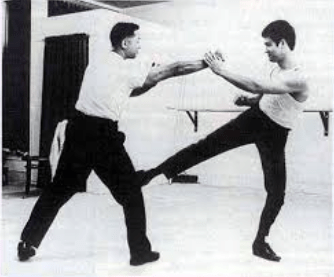
JKD practitioners aim to target their kicks toward their opponent’s shins, knees, thighs, and midsection. These targets are closer to the foot, providing more stability and making them harder to defend against. Nevertheless, as with all other JKD principles, nothing is “written in stone.” If a target of opportunity arises that is above the waist, a practitioner may take advantage without feeling constrained by this principle.
The Four Ranges of Combat
- Kicking
- Punching
- Trapping
- Grappling
Jeet Kune Do students train in each of these ranges equally. According to Lee, this diverse training sets JKD apart from other martial arts, as most traditional systems specialize in one or two ranges. Bruce Lee’s theories have significantly influenced mixed martial arts, with the MMA Phases of Combat essentially representing the same concept as the JKD combat ranges. Historically, these ranges have evolved over time; they were initially categorized as short or close, medium, and long range, but these terms proved ambiguous and later evolved into their more descriptive forms.
Five ways of attack
- Single Angular Attack (SAA) and its converse Single Direct Attack (SDA).
- Hand Immobilization Attack (HIA) and its counterpart Foot Immobilization attack, which make use of trapping to limit the opponent’s function with that appendage.
- Progressive Indirect Attack (PIA). Attacking one part of the opponent’s body followed by attacking another part as a means of creating an opening.
- Attack By Combinations (ABC). This is using multiple rapid attacks, with volume of attack as a means of overcoming the opponent.
- Attack By Drawing (ABD). This is creating an opening with positioning as a means of counterattacking.[30]
Three parts of JKD
JKD practitioners believe that techniques should contain the following properties:
- Efficiency – An attack that reaches its mark
- Directness – Doing what comes naturally in a learned way.
- Simplicity – Thinking in an uncomplicated manner; without ornamentation.
Centerline
The centerline refers to an imaginary line running down the center of one’s body. The theory is to exploit, control and dominate your opponent’s centerline. All attacks, defenses and footwork are designed to preserve your own centerline and open your opponent’s. Lee incorporated this theory into JKD from Wing Chun. This notion is closely related to maintaining control of the center squares in the strategic game chess.
The three guidelines for centerline are:
- The one who controls the centerline will control the fight.
- Protect and maintain your own centerline while you control and exploit your opponent’s.
- Control the centerline by occupying it.
Branches
Although Bruce Lee officially closed his martial arts schools two years before his death, he allowed his curriculum to be taught privately. Since his death, Jeet Kune Do is argued to have split into different groups. They are:
- The Original (or Jun Fan) JKD branch, whose proponents include Taky Kimura, James Lee, Jerry Poteet, and Ted Wong; these groups claim to teach what was believed to be only what was taught by Bruce Lee, and encourage the student to further develop his or her abilities through those teachings. The inherent training principles of this branch are shaped by the static concept of what was “originally taught”, just as the training systems of “traditional” martial arts have been taught for centuries and become recognizable as “styles”, except it is referred to as a philosophy of “style without style”.
- The JKD Concepts branch, whose proponents include Dan Inosanto, Richard Bustillo, and Larry Hartsell; these groups strive to continue the philosophy of individual self-expression through re-interpretation of combat systems through the lens of Jeet Kune Do, under the concept that it was never meant to be a static art but rather an ongoing evolution, and have incorporated elements from many other martial arts into the main fold of its teachings (most notably, grappling and Kali / Escrima material) based on the individual’s personal preferences and physical attributes. The entire JKD “system” can be described through a simple diagram, and the concepts can then be applied to a variety of contexts in a “universal” way.
To understand the branches of JKD it is important to understand the difference between the two “types” or viewpoints of Jeet Kune Do:
- JKD framework: This type of JKD provides the guiding principles. Bruce Lee experimented with many styles and techniques to reach these conclusions. To Lee these principles were truisms. The JKD framework is not bound or confined by any styles or systems. This type of JKD is a process.
- JKD Personal Systems: This type of JKD utilizes the JKD framework along with any techniques from any other style or system to construct a “personal system”. This approach utilizes a “building blocks” manner in which to construct a personalized system that is especially tailored to an individual. Lee believed that only an individual could determine for themselves what the usefulness of any technique should be. This type of JKD is thus a product.
Lee believed that this freedom of adoption was a distinguishing property from traditional martial arts.
There are many who confuse the JKD Framework with a JKD Personal System (IE. Bruce Lee’s personal JKD) thinking them to be one and the same. The system that Bruce Lee personally expressed was his own personal JKD; tailored for himself. Before he could do this, however, he needed to first develop the “JKD Framework” process. Many of the systems that Bruce Lee studied were not to develop his “Personal JKD” but rather was used to gather the “principles” for incorporation in the JKD Framework approach. The uniqueness of JKD to Lee is that it was a “process” not a “product” and thus not a “style” but a system, concept, or approach. Traditional martial arts styles are essentially a product that is given to a student with little provision for change. These traditional styles are usually fixed and not tailored for individuals. Bruce Lee claimed there were inherent problems with this approach and established a “Process” based system rather than a fixed style which a student could then utilize to make a “tailored” or “Personal” product of their own.
The two branches of JKD differ in what should be incorporated or offered within the “JKD Framework”. The Original (or Jun Fan) JKD branch believes that the original principles before Bruce Lee died are all that is needed for the construction of personalized systems.JKD Concepts branch believe that there are further principles that can be added to construct personalized systems. The value of each Branch can be determined by individual practitioners based on whatever merits they deem important.
Original JKD is further divided into two points of view. OJKD and JFJKD both hold Wing Chun, Western boxing and fencing as the cornerstones on Bruce’s JKD.
- OJKD follows all Bruce’s training from early Jun Fan Gung Fu (Seattle period) and focuses on trapping with Wing Chun influence.
- Jun Fan Jeet Kune Do is a signature version of JKD as Bruce taught privately to Ted Wong. This is a later time period and practices a greater emphasis on elusiveness and simplified trapping unique to Bruce’s later approach to combat. The focus is with fencing and Western boxing.
Conditioning
Some exercises Lee did included Da Sam Sing or Gak Sam Sing, a traditional method of forearm conditioning practiced in classical Kung Fu. He also did exercises simulating a fight against a four-limbed human using the traditional Mook Yan Jong used in Wing Chun. Lee was also an avid follower of Pakistani wrestler Great Gama’s training routine. He read articles about him and how he employed his exercises to build his strength for wrestling, incorporating them into his own routine. The training routines Lee used included isometrics as well as “the cat stretch“, “the squat” (known as “baithak”), and also known as the “deep-knee bend.”[31]
Influence and references in popular culture
Kato from Green Hornet is the first fictional character to use Jeet Kune Do, as he was portrayed by Bruce Lee in the 1966 TV series. In the aforementioned TV series, Lee would demonstrate various techniques associated with Jeet Kune Do.[2][32] Following Lee’s impact and death, Kato would utilize JKD in subsequent incarnations of Green Hornet media.
Fighting games
Various video game characters utilize Jeet Kune Do as their choice way of fighting. These include:
- Liu Kang, Johnny Cage and Mokap in Mortal Kombat
- K’ in the King of Fighters uses a style notably similar to Jeet Kune Do, although his fighting style is listed in official profiles as “pure violence.”
- Jacky Bryant and Sarah Bryant[33] from Virtua Fighter
- Marshall Law, Forest Law, and Lee Chaolan from Tekken
- Midknight from Eternal Champions[34]
- Jann Lee from Dead or Alive
- Fei Long from Super Street Fighter II
- Jon Talbain from Darkstalkers
- Chou from Mobile Legends: Bang Bang
References
- Bruce Lee: Dynamic Becoming, p.23
- ^ Jump up to:a b c d Black Belt Magazine, November 1967 issue, pages 14-20 https://books.google.com/books?id=RM4DAAAAMBAJ&dq=black+belt+magazine+kato+jeet+kune+do&pg=PA14
- ^ Jump up to:a b Black Belt: Bruce Lee Collector’s Edition Summer 1993
- ^ Bruce Thomas (1994). Bruce Lee: Fighting Spirit : a Biography. Frog Books. pp. 11–. ISBN 978-1-883319-25-0.
- ^ Jump up to:a b Polly, Matthew (2018). Bruce Lee: A Life. New York: Simon & Schuster. ISBN 9781501187643.
- ^ Glover,Jesse (January 1, 1976). Bruce Lee: Between Wing Chun and Jeet Kune Do. Glover Publications. ISBN 0-9602328-0-X ISBN 978-0-9602328-0-2
- ^ Nilsson, Thomas (May 1996). “With Bruce Lee: Taekwondo Pioneer Jhoon Rhee Recounts His 10-Year Friendship With the “Dragon””. Black Belt Magazine. 34 (5): 39–43. Retrieved November 19, 2009.
- ^ Chris Crudelli (2008). The Way of the Warrior. Dorling Kindersley Ltd. pp. 318–319. ISBN 978-14-0533-750-2. (Regarding Mixed Martial Arts (MMA)) With [Bruce Lee’s] philosophy of “absorbing what is useful and disgarding what is not”, Bruce Lee’s influence can be seen in the dvelopment of MMA.
- ^ Bruce Lee’s Protégé Recalls His Humility Amid ‘Once Upon a Time’ Criticism Archived August 16, 2019, at the Wayback Machine. Variety. July 31, 2019.
- ^ Dana White and the future of UFC Archived October 7, 2018, at the Wayback Machine. Fight Times. October 1, 2004.
- ^ Stets, Michael (July 20, 2013). “The MMA World Pays Tribute to Bruce Lee 40 Years After His Death”. Bleacher Report. Archived from the original on June 19, 2020. Retrieved June 15, 2020.
- ^ Jump up to:a b Chris Crudelli (2008). The Way of the Warrior. Dorling Kindersley Ltd. p. 316. ISBN 978-14-0533-750-2.
- ^ Little, John (1996). The Warrior Within – The philosophies of Bruce Lee to better understand the world around you and achieve a rewarding life (illustrated ed.). McGraw-Hill. ISBN 0-8092-3194-8.
- ^ “Jeet Kune Do”. Bruce Lee Foundation. Retrieved February 1, 2023.
- ^ Jump up to:a b Bowman, Paul (2013). Beyond Bruce Lee: Chasing the Dragon Through Film, Philosophy, and Popular Culture. Columbia University Press. pp. 66–67. ISBN 9780231850360.
- ^ Jump up to:a b Lee, Linda (1975), The Tao of Jeet Kune Do, Ohara Publications Inc., ISBN 0-89750-048-2
- ^ Rafiq, Fiaz (2020). Bruce Lee: The Life of a Legend. Foreword by Diana Lee Inosanto. Birlinn. ISBN 978-1-78885-330-9.
- ^ Tom, Teri (2012). Jeet Kune Do: The Arsenal of Self-Expression. Foreword by Ted Wong. Tuttle Publishing. ISBN 9781462905614.
- ^ Jerry Beasley, Ed.D. (September 2003). (Black Belt Magazine) The Man Who Changed The World: How Bruce Lee Continues to Influence the American Martial Arts. p. 58. ISSN 0277-3066. Inosanto, Lee’s top pupil and teaching assistant, had advanced the art of JKD in the years following his master’s death…
- ^ Thomas 1994, p. 14
- ^ Linda Lee; Mike Lee (1989). The Bruce Lee Story. Black Belt Communications. pp. 26–. ISBN 978-0-89750-121-7. Archived from the original on July 27, 2020. Retrieved November 18, 2019.
- ^ Bruce Haines (November 22, 2011). Karate’s History & Traditions. Tuttle Publishing. pp. 131–. ISBN 978-1-4629-0139-5. Archived from the original on July 27, 2020. Retrieved November 18, 2019.
- ^ Dorgan, Michael. Bruce Lee’s Toughest Fight, 1980 July. Official Karate
- ^ Rossen, Jake (August 10, 2015). “Bruce Lee: The Time Bruce Lee Was Challenged to a Real Fight”. Mental Floss. New York. Archived from the original on July 11, 2016. Retrieved July 10, 2016.
- ^ Original Jeet Kune Do Quarterly Magazine – Issue 11 by Lamar M. Davis II. Blurb Books. December 10, 2020.
- ^ Lee, Bruce (September 1971), “Liberate Yourself From Classical Karate”, Black Belt Magazine, Rainbow Publications, Inc., vol. 9, no. 9, p. 24.
- ^ Pollard, Maxwell (November 1967). In Kato’s Gung-fu Action is Instant. Black belt magazine. pp. 14–20.
- ^ Jump up to:a b Hochheim, W. Hoch (January 1995). “The Maze of Jeet Kune Do”. Black Belt Magazine. Rainbow Publications, Inc. 33 (1): 110.
- ^ Lee, Linda (1975). The Tao of Jeet Kune Do. Ohara Publications Inc. ISBN 0-89750-048-2.
- ^ Inosanto, Dan (1980). Jeet Kune Do: The Art & Philosophy of Bruce Lee. Know Now Publishing Co. pp. 104–106. ISBN 0-938676-00-8.
- ^ Little, John, _Bruce
İnsanlar Neler Diyor?
“Umarim uzun yillar Jeet Kune Do ile ilgili yaptigim arastirma ve calismalarin sonucu derledigimiz bu calisma Turkiye´deki Jeet Kune Do ogrencilerimiz icin faydali olur.”

Sifu Robert T.Ates
“Turkiye´de Bruce Lee´nin original antreman teknikleri ile gercek Jun Fan Jeet Kune Do´yu ogrenmek isteyen tum sporcularimiza Ozakdag Spor kulubumuzun kapilari aciktir.”

Sifu Erkan Ozakdag
“Her iki Sifum ile de calismis olmaktan, Lee´nin original antreman teknikleri ile JF Jeet Kune Do ogrenmekten buyuk ketif aldigimi belirtmek isterim. Bruce Lee oldu, mirasi yasiyor!”

Mike Abraham
 JEET KUNE DO WORLDWIDE BRUCE LEE´s MARTIAL ARTS